Inner Heliosphere
Angular broadening as a probe of coronal turbulence
Key findings
- Tau A (Crab Nebula) can be observed with the Sun at meter-decameter wavelengths during conjunction.
- OVRO-LWA observations at 30-80 MHz sample projected heliocentric distances of about 5-27 R⊙.
- Angular broadening strengthens toward smaller impact parameter and lower frequency.
- Near closest approach, the source becomes arc-like and shows low-frequency substructure consistent with mesoscale density inhomogeneities.
The Crab Nebula (Tau A) passes through solar conjunction each mid-June. In optical wavelengths, it is outshone by the Sun. At meter-decameter wavelengths, the contrast is more favorable: Tau A can still be imaged together with the Sun using instruments with sufficient field of view and dynamic range.
During conjunction, radio emission from Tau A propagates through heliospheric plasma and becomes broadened and distorted. This propagation effect provides a useful remote diagnostic of turbulent density structure in the extended corona and inner heliosphere.
This effect was anticipated early in radio astronomy. Figure 1 compares the classical isotropic-scattering expectation (Hewish 1958) with 2024 OVRO-LWA observations.
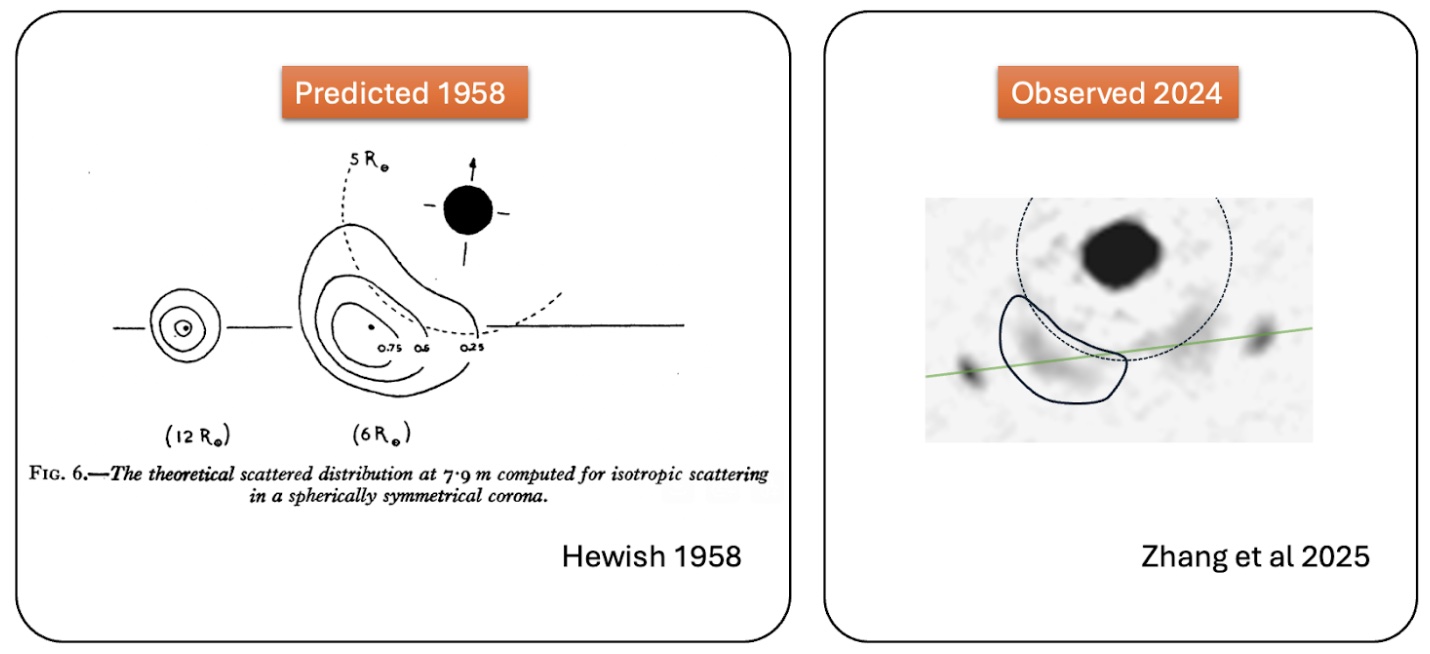
In 2024, we observed Tau A with the Owens Valley Radio Observatory Long Wavelength Array (OVRO-LWA), imaging 30-80 MHz at projected heliocentric distances of about 5-27 R⊙. Daily wide-field images were used to quantify scattering variation with frequency and impact parameter, including dates near closest approach (for example, June 9, 14, and 22).
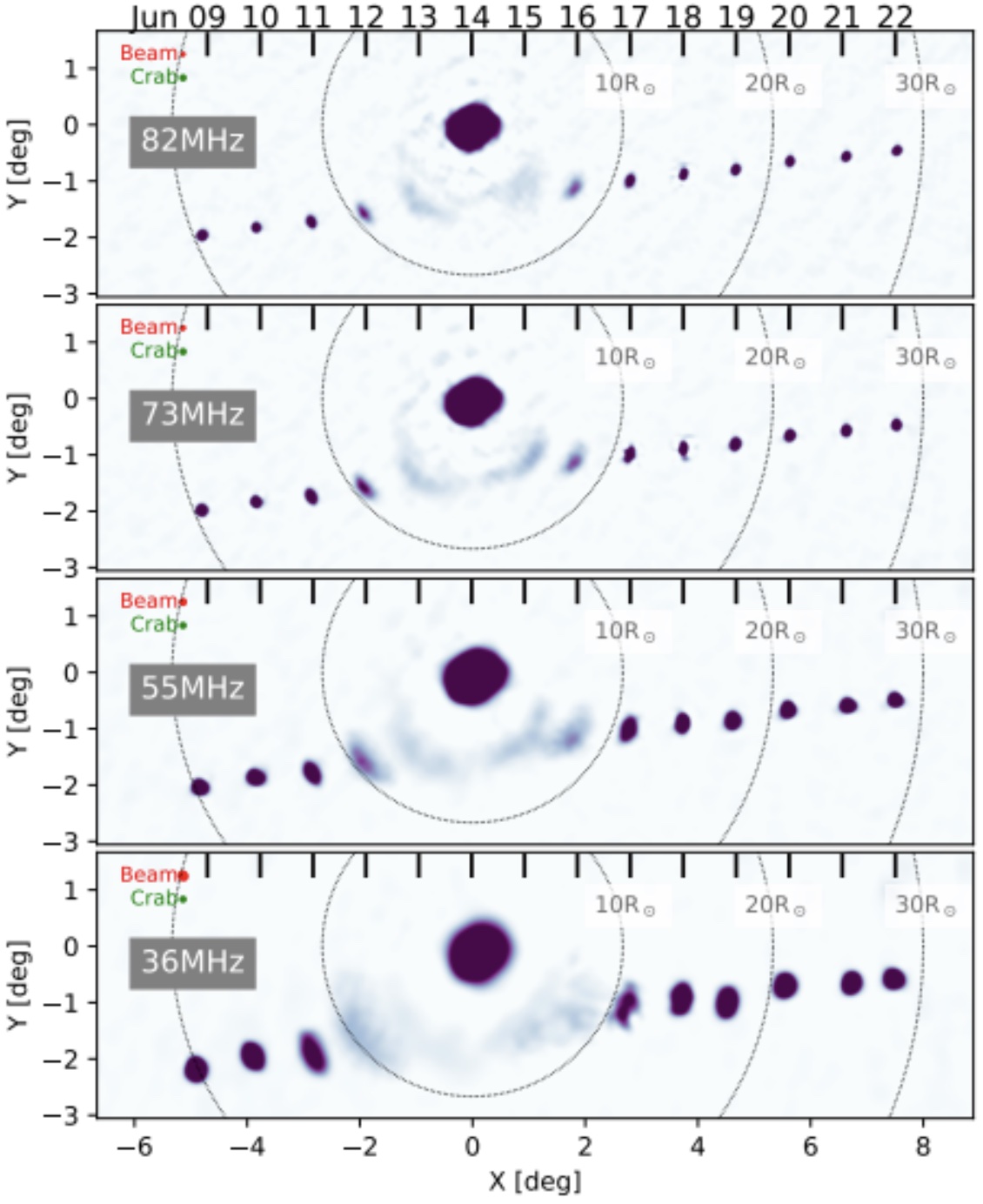
Angular broadening measurements indicate that anisotropy decreases along the radial direction. Near closest approach, the source morphology becomes arc-like, and low-frequency substructure appears when the line of sight crosses dense coronal streamers. Total flux also decreases toward lower frequency and smaller impact parameter, consistent with stronger scattering and absorption.
Together, these measurements constrain how magnetic-field-guided turbulence varies with heliocentric distance and how propagation alters apparent source size, shape, position, and flux.
FAQ
Why use Tau A for inner-heliosphere studies?
Tau A is a bright, compact background radio source. During solar conjunction, its signal is strongly modified by plasma along the line of sight, making it a sensitive probe of coronal and heliospheric turbulence.
What does angular broadening tell us physically?
Angular broadening tracks the scattering strength of density fluctuations. Its dependence on frequency and impact parameter provides constraints on turbulence properties and plasma structure in the propagation medium.
Related publication
Zhang, P., Mondal, S., Chen, B., Yu, S., Gary, D. et al. (2025), "Probing the Turbulent Corona and Heliosphere Using Radio Spectral Imaging Observation during the Solar Conjunction of Crab Nebula," The Astrophysical Journal. doi:10.3847/1538-4357/adff56 · IOP · arXiv:2506.01632
Classical reference
Hewish, A., "The scattering of radio waves in the solar corona," MNRAS 118, 534-546 (1958). ADS
Interplanetary Scintillation (IPS)
(to be finished)